

ARTICLE II: THE IDEOLOGICAL EXPOSÉ
The Cockroach Janta Party's Manifesto of Convenient Contradictions
THIS ARTICLE IS A PART OF A SERIES; "THE CJP DOSSIER: the manufactured revolt"
YOU ARE CURRENTLY READING THE 2ND PART, BEFORE READING THIS PLEASE MOVE TO THE 1ST PART "ARTICLE I:THE OPERATIONAL EXPOSÉ Cockroach Janta Party: The Architecture of a Manufactured Revolution"
Have a productive and thought provoking read,
Abhijeet Dipke has a NEET problem. Not the NEET-UG 2026 paper leak, which he has weaponised with considerable professional skill, but a deeper, structural NEET problem: he believes simultaneously in two things that cannot both be true. He believes, loudly and publicly, that NEET's integrity must be protected so that deserving students receive the seats they earn through merit, that the paper leak destroyed a fair meritocratic system, that honest preparation must be rewarded, and that systemic accountability is necessary to preserve examination integrity. He also publicly endorsed Arvind Kejriwal's Goa election promise of 80 per cent reservation in private sector jobs. "Goa youth have to go outside the country for jobs," Dipke has stated. "If Arvind Kejriwal gives 80 per cent reservation in private jobs, then youth won't have to go outside." The CJP's own manifesto calls for 55 per cent women's reservation in Parliament, 7 per cent beyond the Nari Shakti Vandan Adhiniyam's 33 per cent, on the explicit basis that demographic representation overrides competitive selection. So: merit must be preserved for NEET. Merit must be overridden at 80 per cent for private employment. Merit must be overridden at 55 per cent for Parliament. The synthesis of these positions is not a political philosophy. It is the operational definition of saying whatever generates the most applause from whichever audience you are currently addressing.
The economic arithmetic of Dipke's Goa position is not ambiguous. Goa's economy runs on tourism, hospitality, small manufacturing, and services, sectors in which private investment is the engine of employment, not the state. A mandatory 80 per cent reservation requirement in private hiring does not produce 80 per cent employment for local youth. It produces reduced private investment as businesses calculate compliance costs and legal exposure, smaller hiring pools as companies work beneath the threshold that triggers the mandate, systematic flight of businesses to neighbouring states, and the replacement of competitive hiring with quota compliance as the primary criterion for employment decisions. The historical evidence from states that have imposed high private-sector reservation, Maharashtra and Karnataka at various points, shows not employment booms but business relocation and reduced investment in covered sectors. Dipke's solution to Goa youth going abroad for jobs is a policy that would guarantee fewer private-sector jobs in Goa. His diagnosis of youth unemployment is accurate. His prescription is the cause of the disease he is diagnosing. That this contradiction never receives the interrogation it deserves says less about the quality of Dipke's economic thinking than about the quality of attention that India's viral political commentary gives to policy substance over rhetorical performance.
"Hypocrisy is the homage that vice pays to virtue."
— François de La Rochefoucauld, Maxims (1665)
The CJP's manifesto exposes the same internal contradiction on a larger scale. Consider the five demands with the care their authors never applied to their logic. The ban on Rajya Sabha seats for retired Chief Justices targets a pathway that has primarily benefited judges seen as friendly to the central government. It does not extend to any other post-retirement political reward: not governorships for ruling-party loyalists, not Rajya Sabha nominations for allied regional parties, not the entire ecosystem of post-retirement patronage that spans state and central governments across party lines. The demand to cancel media licences owned by Ambani and Adani names specific businessmen and their specific media holdings, without a syllable of criticism directed at Rajdeep Sardesai's institutional legacy, Ravish Kumar's documented NDTV editorial politics, or the documented left-liberal tilt in legacy print media. The 20-year ban on political defectors targets the electoral horse-trading that has most visibly characterised Operation Lotus and its equivalents, operations conducted primarily by the ruling party. Not one demand in the CJP's manifesto requires anyone who supports AAP, Congress, or Trinamool to do anything differently. This is mathematically improbable in a country where every major party has demonstrated corruption, defection, and institutional capture at some point. It is, however, perfectly consistent with a manifesto drafted by someone who spent five years in AAP government communications.
The West Bengal comparison crystallises Dipke's ideological framework more sharply than any other single data point. He described the prospect of BJP electoral success in West Bengal as the state "becoming what Taliban is to Afghanistan." The West Bengal Assembly election results of May 2026 are now a matter of public record: BJP won 206 seats out of 294, ending Mamata Banerjee's 15-year rule in what was described as a historic mandate. The people of West Bengal, not a think-tank, not a foreign commentator, not a social media movement, delivered the most definitive electoral verdict against an incumbent state government in recent Indian history. Dipke's characterisation of this democratic outcome as Talibanisation is not provocative rhetoric. It is the description of a free election with full voter turnout and international observer presence as equivalent to the Taliban's violent conquest of Afghanistan, where no election occurred and every institution of civil society was dismantled at gunpoint. Under Mamata Banerjee's 15 years, West Bengal recorded systematic post-poll violence that killed thousands, a teachers' recruitment scam that cheated lakhs of qualified candidates out of government employment, sand mafias operating under political protection, a syndicate raj that controlled transport, construction, and education, and a consistent last-place ranking among large Indian states in human development indices. Dipke has called Mamata a "brave fighter." For what, exactly, and against whom, is a question that has not been asked of him with the persistence it deserves.
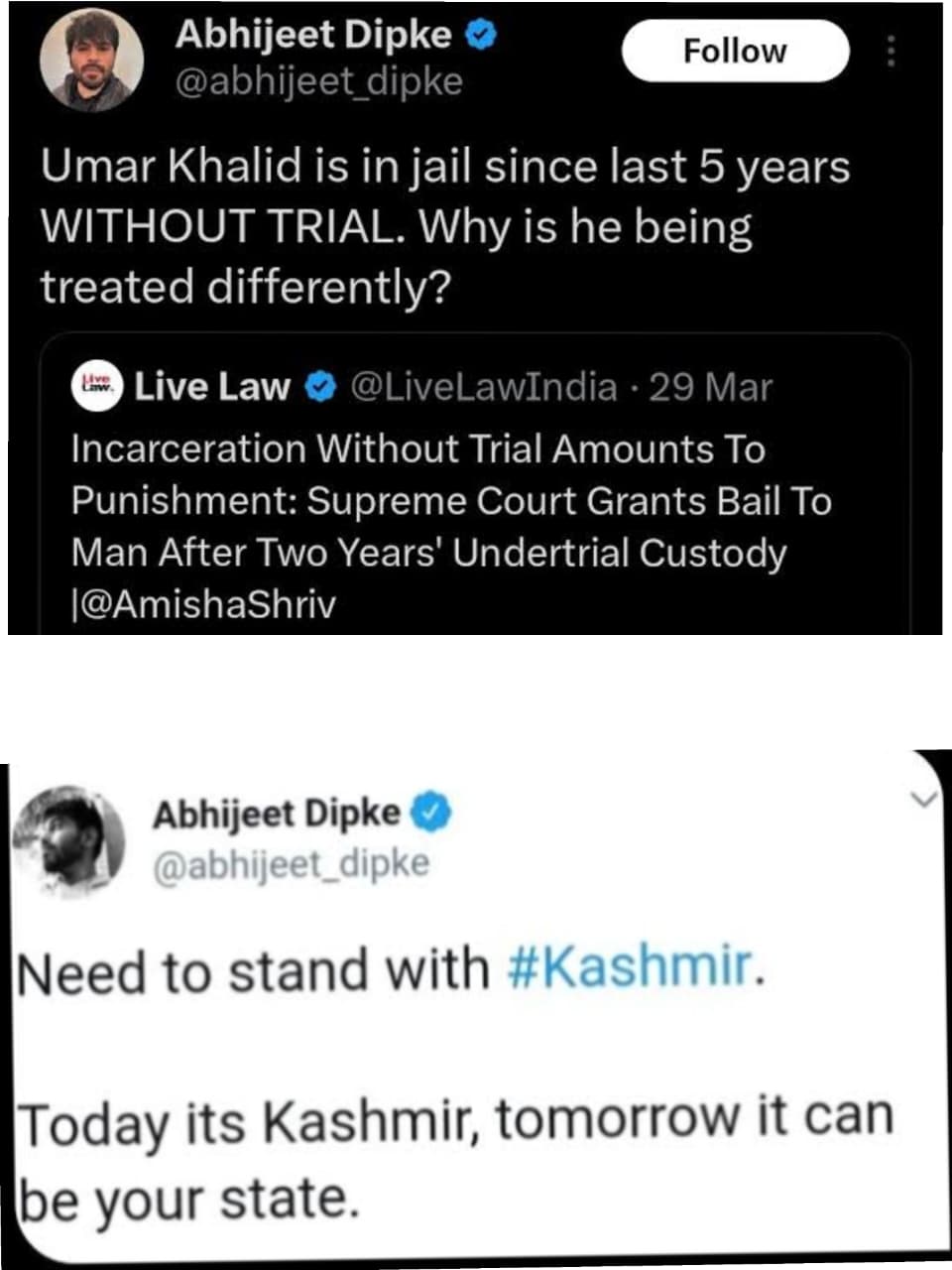
The Article 370 position is where the ideological map becomes impossible to misread. On August 5, 2019, as the Government of India abrogated Article 370 and Article 35A, Dipke posted on Twitter: "Need to stand with Kashmir. Today it's Kashmir, tomorrow it can be your state." He defended the separate constitutional framework, amplified the "Kashmir bleeds" narrative, and Legal Rights Observatory filed a complaint requesting FIR registration for spreading what they characterised as a separatist narrative. Dipke's implicit prediction was that the abrogation would deepen instability, that Kashmiris would resist integration, that the model of special status was necessary for the region's peace. The data since 2019 does not support a single element of that prediction. In 2019, stone-pelting incidents numbered 618 in the January-to-July period alone. In 2024, the number was zero, not reduced, zero. Organised hartals and shutdowns that had paralysed civilian life for decades? None since 2023. Tourist arrivals, which had been suppressed for decades by violence and instability, reached 1.89 crore in 2022, the highest in 75 years, then 2.11 crore in 2023, then a record 2.36 crore in 2024. Tourism now contributes 7 per cent to J&K's GSDP, valued at Rs 18,550 crore in nominal terms. The GSDP itself doubled from Rs 1.17 lakh crore in 2015-16 to Rs 2.45 lakh crore in 2023-24. Per capita income is projected to rise 10.6 per cent to Rs 1,54,703. The Chenab bridge, the world's highest railway bridge, was completed. Cinema halls that had been shuttered for decades reopened. Investment proposals worth Rs 1.69 lakh crore arrived. Local militant recruitment dropped from 129 in 2019 to one in 2025. None of this data appears in the CJP's political vocabulary. Not the tourism record. Not the stone-pelting zero. Not the GSDP doubling. Dipke, who claimed in 2019 that standing with Kashmir meant opposing integration, has not revisited that position in light of the comprehensive empirical evidence that integration produced precisely the peace, development, and normalcy that Article 370's defenders insisted would be destroyed. This is not a minor omission in someone who presents himself as a data-driven accountability voice. This is a fundamental refusal to acknowledge that a major political judgment he made in public turned out to be wrong in every measurable dimension. The people whose actual lives improved, the Kashmiri tourism operator, the student who can now buy property anywhere in India, the family whose street no longer has stone-pelting, are invisible to the CJP's narrative of oppression because acknowledging their improvement would require acknowledging the failure of the narrative Dipke promoted.
"Facts are stubborn things; and whatever may be our wishes, our inclinations, or the dictates of our passion, they cannot alter the state of facts and evidence."
— John Adams, Argument in Defence of the Soldiers in the Boston Massacre Trials (1770)
The Nepal comparison deserves its own paragraph because it exposes the movement's deepest intellectual vanity. Nepal's Gen Z, in 2025, went into the streets at genuine personal risk, toppled a government, installed an interim Prime Minister, and then delivered the Rastriya Swatantra Party a landslide in the subsequent election, with young people winning actual political power through actual courage and actual sacrifice. When asked whether CJP would follow Nepal's example, Dipke said no — that Indian youth are "smarter" than to risk themselves in street protest, that safe satirical memes are the sophisticated approach, that going to the streets the way Nepal's youth did would be less intelligent. There is a word for declaring that the people who took real risks and achieved real change were less intelligent than those who stayed home making memes. It is not compliment. It is rationalisation. It dresses comfort as strategy, safety as wisdom, and the absence of courage as the superiority of method. Nepal's Gen Z is now governing. CJP's Gen Z is arguing about cockroach costumes at Yamuna clean-up drives. The difference in outcomes is not a vindication of India's "smarter" approach. It is the natural consequence of mistaking viral content for political power.
The Dhruv Rathee endorsement clarifies what CJP ultimately is in ideological terms. "We admire him very much," Dipke has said of the YouTuber with 18 million subscribers whose content is systematically critical of the BJP and the Modi government, consistently sympathetic to the AAP and Congress narrative, and has never, across hundreds of videos, subjected the corruption scandals of AAP governance, the post-poll violence of Trinamool, or the economic performance of Congress-ruled states to the same forensic intensity it applies to the ruling party. CJP admires Rathee. CJP's manifesto targets Ambani and Adani media. CJP's founder endorsed Sisodia's record and called Mahua Moitra "the fighter democracy needs." CJP describes West Bengal's democratic election as Talibanisation. CJP calls Mamata Banerjee a brave fighter while her government's teachers' recruitment scam cheated lakhs of candidates out of the exact kind of merit-based public employment that CJP claims to defend. The movement that demands merit for NEET is silent on merit in West Bengal. The movement that demands transparency from the government collects UPI donations with no audit trail. The movement that claims to oppose all parties endorsed three of them within a fortnight. The ideological framework is not difficult to decode. It is simply the AAP political worldview, professionally packaged in cockroach branding, targeted at a generation young enough not to have watched it be deployed the first time
The Cockroach Janta Party will, in all likelihood, survive this scrutiny — not because the scrutiny is wrong, but because the audience it is designed for has been trained to distrust scrutiny itself. Every factual challenge becomes establishment pushback. Every documented contradiction becomes proof of how threatened the powerful feel. This is not a bug in the CJP's design; it is the design. A movement that has insulated itself from accountability by rebranding accountability as oppression has not built a political vision. It has built a closed circuit. And a generation that came of age demanding that institutions be held to evidence, that power answer for its contradictions, that the comfortable be made uncomfortable — that generation deserves something more than a professionally manufactured echo of its own frustrations, monetised through UPI links and delivered in cockroach branding. It deserves the harder, slower, less photogenic work of holding every actor to the same standard, regardless of which side of the crocodile-cockroach binary they occupy. That is not a ask the CJP has ever made of its audience. The reason, by now, should be obvious.............
JAI JAWAN, JAI KISAN, JAI VIGYAN, JAI ANUSANDHAN
JAI HIND
(0) Responses
Share your thoughts on this post.
No comments yet.